What Is Topical Authority in SEO? A Working Definition
Summary
Topical authority measures how comprehensively a site covers a specific subject area, not how many backlinks it holds. Google evaluates content clusters, internal linking density, and breadth of coverage to decide whether a domain is a trustworthy source on a topic. Building it requires deliberate architecture: a pillar page, 25 to 30 interlinked cluster articles, and disciplined internal linking. Volume alone does not produce topical authority. Structural coherence does.
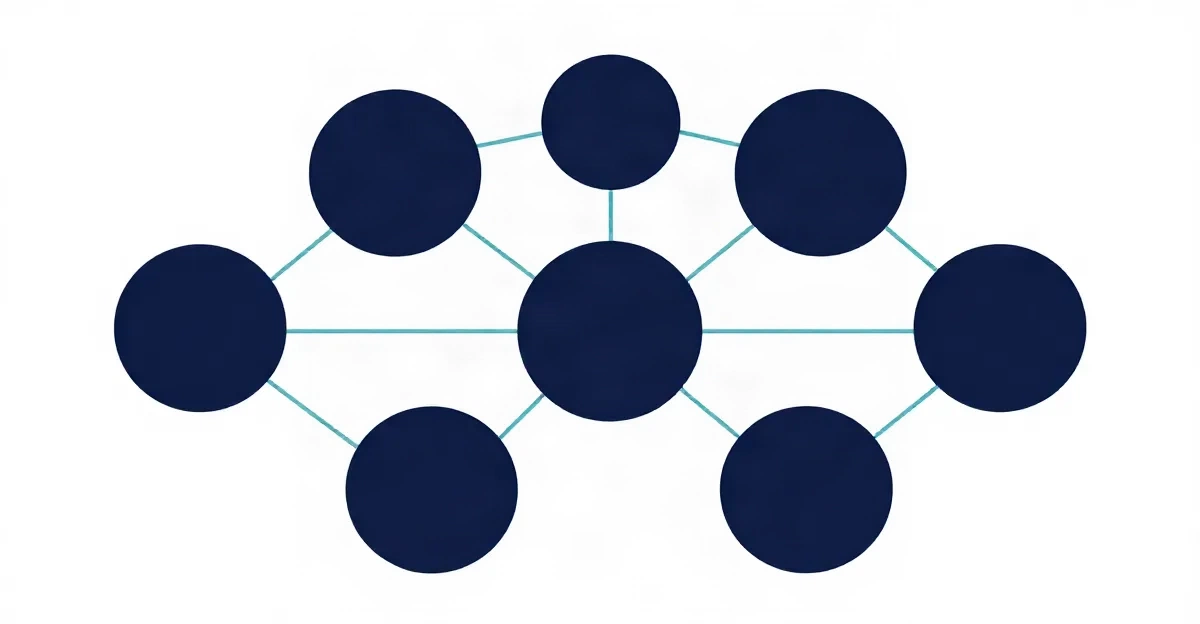
What is topical authority, and why does it matter more than domain authority in 2026? Topical authority is the degree to which a website is perceived by search engines as a reliable, comprehensive source on a specific subject. It is not a ranking score, a proprietary metric, or a single tool readout. It is the pattern Google infers when it finds a coherent body of interconnected content addressing every meaningful angle of a topic. For SaaS blogs publishing at scale, it is what separates a site that ranks occasionally from one that ranks persistently.
Why a single expert article seldom holds

The instinct for most teams is to publish one definitive guide. One pillar article covering the target topic from every angle: why it works, the tools involved, the common pitfalls, the measurement framework. Something thorough and well-sourced that should, by rights, rank for every related term.
In practice, what Google reads is different. Its systems evaluate the topic at the domain level, not the page level. Not this article, but what the site knows about the subject across all its pages. A single thorough article published alongside unrelated content reads as isolated expertise, not structural authority.
At the usage level, what holds consistently is that the site with twenty interconnected articles covering different facets of a topic outranks the site with one 5,000-word guide on the same subject, even when the single article is technically superior in isolation. The signal Google weighs is coherence across the domain, not the length or density of any individual page.
Publishing random, unconnected blog posts compounds the problem. Each post that does not link to or support a coherent cluster dilutes the topical signal rather than building it.
The pillar-cluster model without simplification

The operational framework most SEO practitioners use is the pillar-cluster model, also called hub-and-spoke. The structure is straightforward: one broad pillar page covers the central topic at a high level, and multiple cluster pages each address a specific subtopic in depth.
Every cluster page links back to the pillar. The pillar links out to each cluster page. Internal linking is not decorative here. It is the mechanism that signals topical coherence to crawlers. When a new article is published, it should link to two or three existing articles that are semantically adjacent. This is the active maintenance that keeps a cluster coherent as it grows.
The threshold that tends to make this system measurable is around 25 to 30 tightly connected articles within a single cluster. At that volume, sites with coherent internal linking typically see a 40 to 70 percent increase in keyword rankings for the target topic within three to six months. The content still needs to address real search intent at each node, but the structural foundation accelerates the signal.
What distinguishes a content cluster from a loose collection of blog posts is intent alignment at each level. The pillar targets broad informational queries. The cluster pages target specific queries that are often more commercial or navigational. Together, they map the full surface of how users actually search within a topic.
The test for whether a cluster is real: can each article stand without the others? If fifteen articles target slight variations of the same query with minor rewrites and no cross-linking, that is not a cluster. That is cannibalization dressed as volume.
Topical authority vs. domain authority: two different signals
The confusion between topical authority and domain authority is understandable. Both affect rankings. Both take time to build. But they measure different things and respond to different inputs.
Domain authority, whether expressed as Moz's Domain Authority, Ahrefs' Domain Rating, or Semrush's Authority Score, measures the strength and quality of a site's backlink profile. It is a global signal. A site with strong domain authority has demonstrated trustworthiness across the web through citations from other sites.
Topical authority is narrower and more specific. It measures how comprehensively and consistently a site covers a particular subject. A site with a strong domain rating can rank poorly for a specific query if its coverage of the relevant topic is thin. Conversely, a focused, well-structured site with modest backlink numbers can outrank it for specific queries through topical depth.
In April 2024, Google's Gary Illyes stated that links are no longer among Google's top three ranking factors. The framing that now holds: topical authority drives niche visibility and AI citation eligibility, while domain authority supports broader trust signals. Neither replaces the other, but the relative weight has shifted.
What changed after the March 2026 core update

The March 2026 core update consolidated a shift that had been building since the Helpful Content updates of 2022 through 2024. Google formalized its evaluation of content at the domain level, not the page level.
Before that update, individual pages could rank on the strength of their content alone, even without a coherent surrounding cluster. After it, that pattern became less reliable. Pages without topical context, without a cluster of related content supporting them, started losing positions to pages that were structurally embedded within a topic.
The update also raised the stakes for AI-generated content, not because such content is penalized per se, but because the quality signal that now matters most is coherence across the site. Does every article on the subject contribute something distinct? Do the internal links reflect a logical content architecture? Volume without structure became a clear liability after March 2026.
For programmatic publishers, this is the binding constraint. Generating 500 articles does not build topical authority if a significant share of them cover the same subtopic with minor variation and no cross-linking. The crawler can read the structure, and the absence of it registers as thin coverage.
AI citations and topical structure
One dimension that became measurable in 2025 is the relationship between topical authority and citation in AI search systems. Yext's AI Citation Study analyzed 6.8 million citations from 1.6 million queries across ChatGPT, Gemini, and Perplexity between July and August 2025 and found that 86 percent of all AI citations came from brand-managed sources, primarily structured, authoritative websites.
Sites with coherent topic cluster architecture consistently outperformed isolated article publishers in citation frequency. The mechanism is plausible: AI retrieval systems tend to surface sources that cover a topic comprehensively, not just sources that have one well-optimized page. Topical structure is, in this reading, a prerequisite for AI visibility as much as it is for traditional organic rankings.
This does not mean that chasing AI citations is the right editorial frame. It means that the same structural work that builds organic topical authority also increases the probability of being surfaced in AI-generated answers. The two objectives are not in tension.
How to audit your current topical coverage
Before building, it is useful to measure what already exists. The audit process is not complex, but it requires discipline to execute without shortcuts.
Start by listing every article on your site that addresses a given topic. For each, note the primary keyword, the approximate word count, and which other articles it links to. This produces a rough map of your current cluster. The patterns to look for: gaps where subtopics are not covered, orphans where articles receive no internal links from related pages, and cannibalization where multiple articles target the same query without differentiation.
Tools like Ahrefs' site audit and Semrush's topic research module can accelerate this process considerably. MarketMuse's competitive gap analysis is particularly useful for identifying which subtopics your competitors cover that you do not.
Frase can help map search intent across the cluster at the brief stage, before writing begins rather than after. The audit is not a one-time exercise. For a site publishing at volume, a quarterly review of the cluster map is closer to the right cadence.
What building topical authority requires in practice
The practical requirements are four: a coherent topic selection, a structured brief for each article in the cluster, disciplined internal linking, and enough volume to establish density within the cluster.
Topic selection is where most teams underestimate the constraint. Topical authority is built within a bounded subject area. Spreading content across three adjacent topics, say, programmatic SEO, content marketing strategy, and copywriting technique, fragments the signal across all three rather than building depth in any. The stronger position is to reach the 25-article threshold on one topic before expanding to the next.
Brief quality matters more than most teams expect. A cluster of 30 articles on the same topic will overlap heavily unless each brief explicitly defines the search intent being served, the entity being covered, and which existing articles in the cluster it should link to. Structural coherence requires editorial discipline at the brief stage, not just at the writing stage.
Internal linking is the mechanism, not the afterthought. Every cluster page should link back to the pillar. The pillar should link out to every cluster page. When a new article is published, it should establish connections to two or three existing articles that are semantically adjacent. This is not optional for topical authority: it is how the coherence signal is transmitted to crawlers.
Surfer SEO's content editor surfaces internal link opportunities in real time during drafting. Clearscope's topic model flags which related concepts the article should cover to sit within the cluster coherently.
The honest version of the timeline
Building topical authority takes longer than most teams plan for. The technical foundation, a pillar page with an initial cluster of eight to ten articles and proper internal links, can be established in four to eight weeks. The signal that produces measurable ranking gains typically takes three to six months to stabilize, assuming the cluster reaches the 25-article threshold and the content addresses distinct search intent at each node.
This is not a criticism. It is a measure. Teams that expect faster returns often publish faster to compensate, generating content that fragments rather than builds the cluster. The discipline is to hold the structure even when early results are modest.
At the usage level, what holds over time is not the fastest cluster but the most coherent one. A site that adds one well-structured article per week to a tight cluster of 25 will outperform a site that publishes five thin pieces per week with no internal linking strategy, even when the latter site has a higher domain authority.
The constraint that makes this worth naming explicitly: topical authority is not something that can be purchased or shortcut through backlink acquisition. It is built article by article, cluster by cluster, with each piece contributing a distinct node to a coherent map. That is both its difficulty and its durability.
This article was produced via EsyBlog. The system generates structured long-form content at scale. The editorial decisions, topic selection, structure, sourcing, are made upstream.